
Home » Industrial Wastewater Applications » Industrial Lime Softening
Home » Industrial Wastewater Applications » Industrial Lime Softening

Turn complex industrial streams into a reusable resource — reliably, compactly, and cost‑effectively.

Industrial water reuse and zero‑liquid‑discharge (ZLD) strategies increasingly rely on the effective removal of hardness, silica, and other dissolved species. Whether treating cooling tower blowdown or recovering value from NF or RO brines, operators need lime softening solutions that deliver stable performance, protect downstream membranes, and remain reliable despite fluctuating water quality.
With decades of experience in membrane technology for demanding industrial effluents, Berghof Membranes supports OEMs worldwide in the treatment of complex process streams. Our ultrafiltration membranes, combined with chemical precipitation, form a proven and robust barrier that safeguards downstream processes and enables efficient water reuse across a wide range of industries, including power generation, chemical manufacturing, oil & gas, mining, electronics, and demineralized water production.
Engineered to handle high solids loads, aggressive chemistry, and harsh operating conditions, Berghof’s CR modules deliver consistent performance where conventional filtration technologies reach their limits. The result is a reliable foundation for sustainable water management, helping customers move confidently toward their water reuse and ZLD strategies.
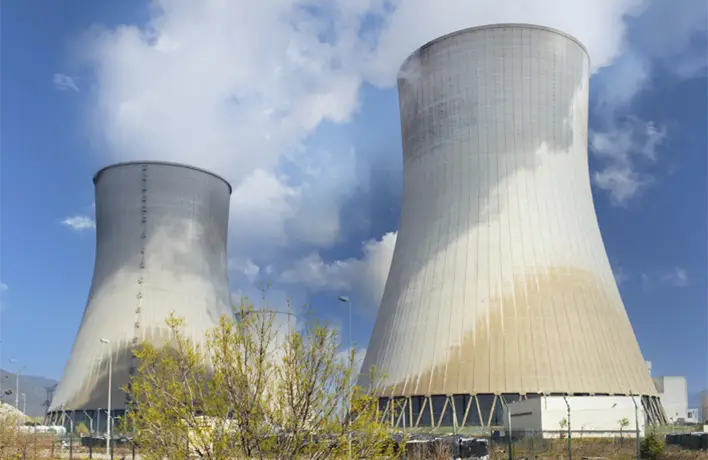
Cooling tower blowdown contains elevated concentrations of hardness, alkalinity, silica, and conditioning chemicals, which restrict reuse and increase freshwater consumption. Lime softening effectively removes calcium and magnesium, allowing higher cycles of concentration and significantly reducing blowdown volumes.
When combined with tubular ultrafiltration, the precipitates formed during softening are fully retained, ensuring reliable solid–liquid separation. The result is a well‑clarified permeate suitable for internal reuse or further treatment with RO systems, improving overall water efficiency and operational stability.
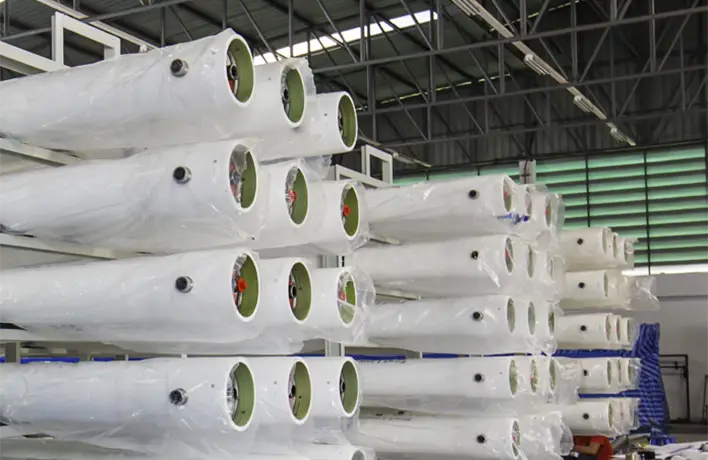
Reverse osmosis or Nanofiltration rejects are increasingly viewed as a valuable resource rather than a waste stream. Through lime precipitation, hardness, silica, and other scaling species are removed, eliminating key limitations for further water recovery in downstream RO, thermal concentration, or evaporation units.
Tubular UF membranes provide a highly robust clarification step, reliably handling the high solids loads generated during precipitation. By protecting high‑pressure membranes and critical downstream equipment, UF enables higher recovery rates and supports the implementation of efficient and resilient ZLD schemes.
Industrial lime softening is based on controlled chemical reactions that convert dissolved species into insoluble precipitates:
Dissolved calcium and magnesium react with lime and soda ash to form calcium carbonate and magnesium hydroxide precipitates. The following provides an overview of the key chemical reactions:- Lime (calcium hydroxide) is added to hard water to remove carbonate hardness. Calcium bicarbonate and magnesium bicarbonate react with lime to form precipitates of calcium carbonate (CaCO₃) and magnesium hydroxide (Mg(OH)₂): Ca(HCO₃)₂ + Ca(OH)₂ → 2CaCO₃(s) + 2H₂O Mg(HCO₃)₂ + 2Ca(OH)₂ → 2CaCO₃(s) + Mg(OH)₂(s) + 2H₂O- Excess lime is used to react with soluble magnesium salts (non-carbonate or permanent hardness), forming insoluble magnesium hydroxide: Mg²⁺ + Ca(OH)₂ → Mg(OH)₂(s) + Ca²⁺- The previous step has simply replaced the magnesium with calcium. Soda ash (sodium carbonate) is added to remove non-carbonate hardness due to calcium ions: Ca²⁺ + Na₂CO₃ → CaCO₃(s)+ 2Na⁺
Silica is removed by adsorption and coprecipitation with the Mg(OH)2 precipitate formed in the softening reaction. When magnesium ions are not enough for removing all the silica, MgO or MgCl2 is added for further silica removal. Data indicate that for effective silica co-precipitation, the magnesium ion concentration should be approximately 2.5 times that of the silica concentration. When supplementing magnesium salts, an equivalent amount of alkali needs to be added to react with these magnesium salts.
Dissolved metals are converted into insoluble particles by increasing the solution pH through the addition of lime or caustic soda, leading to the formation of metal hydroxides. Each metal exhibits an optimal precipitation range at a specific pH, which must be carefully controlled to maximize removal efficiency. As an alternative, sulfide precipitation using sodium sulfide (Na₂S) can be applied to form metal sulfides. Compared with hydroxide precipitation, sulfide precipitation can achieve lower residual metal concentrations and is less sensitive to the presence of complexing agents.
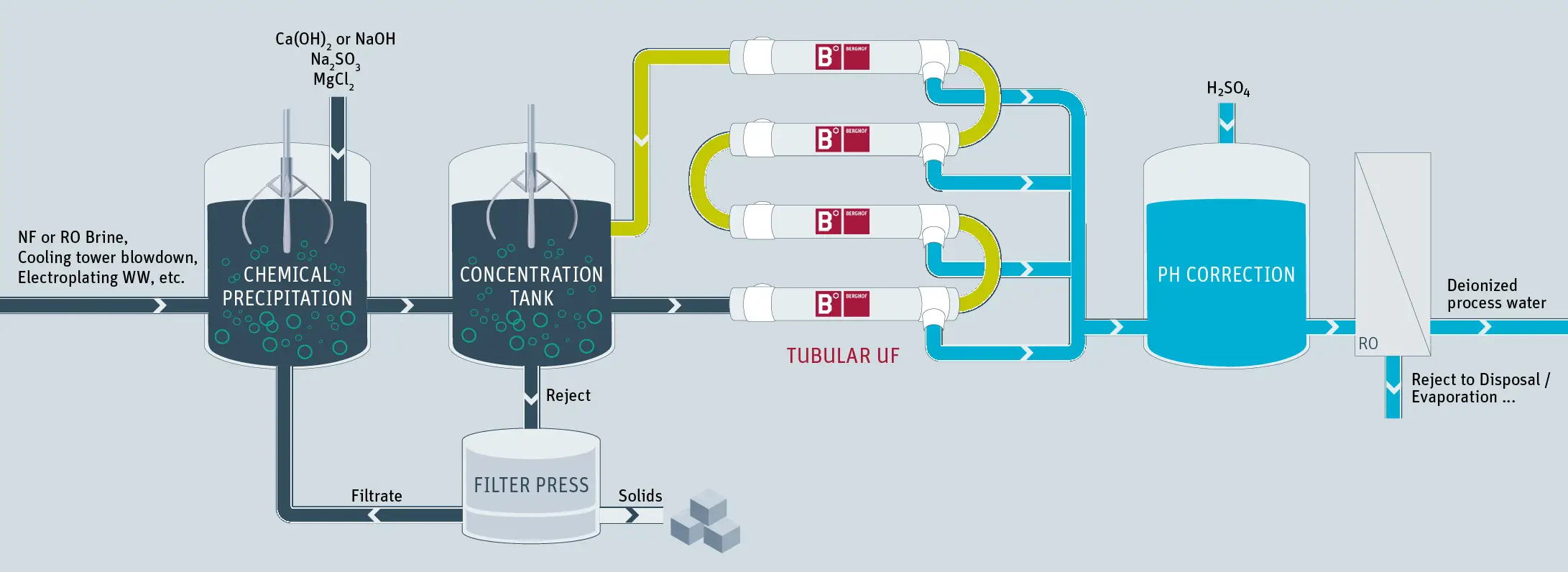
In a typical lime softening process coupled with tubular UF, wastewater enters the precipitation tank where lime and other reagents are dosed under controlled pH conditions. Mechanical mixing ensures complete reaction and uniform formation of precipitates.
The precipitate‑laden water is then fed directly to tubular UF modules. The membranes act as a physical barrier, producing a high‑quality permeate free of suspended solids and a concentrated reject stream. The reject is dewatered using a filter press, while the clarified permeate can be routed to RO, evaporation, or reused directly in the process.
Superior effluent quality
Significantly superior to that of clarifier-treated water: 100% suspended solids removal, turbidity less than 1 NTU and SDI is less than 3.
Unmatched process reliability
Fluctuations in feed water quality often compromise the performance of clarifiers and sand or multimedia filters. In contrast, UF membranes act as a complete physical barrier for precipitates, guaranteeing solids‑free permeate regardless of process upsets.
Compact plant layout
UF enables a single separation step upstream of RO, substantially reducing plant footprint. Compared with conventional solutions based on clarifiers, multimedia filters, and polishing UF, footprint is reduced by more than a factor of three.
Simplified post-treatment
UF permeate can be directly fed to RO systems in ZLD projects. In contrast, a clarifier requires additional intermediate steps, such as multimedia filter and/or hollow fiber UF membranes.
Less chemicals
Coagulants are typically not required or, if needed due to the presence of organic matter, the dosage is greatly reduced. No flocculants are needed, and excess lime addition to promote coagulation of small precipitates is avoided. Overall, chemical savings of 25 – 30 % compared with gravity settling are commonly achieved.
Lower sludge production
By eliminating excess lime, coagulants, and flocculants, UF based systems generate significantly less sludge, reducing handling, dewatering, and disposal costs.
Simplified maintenance
The absence of multimedia filters eliminates the need for backwashing systems, filter media replacement, and associated downtime, resulting in simpler operation and lower maintenance requirements.
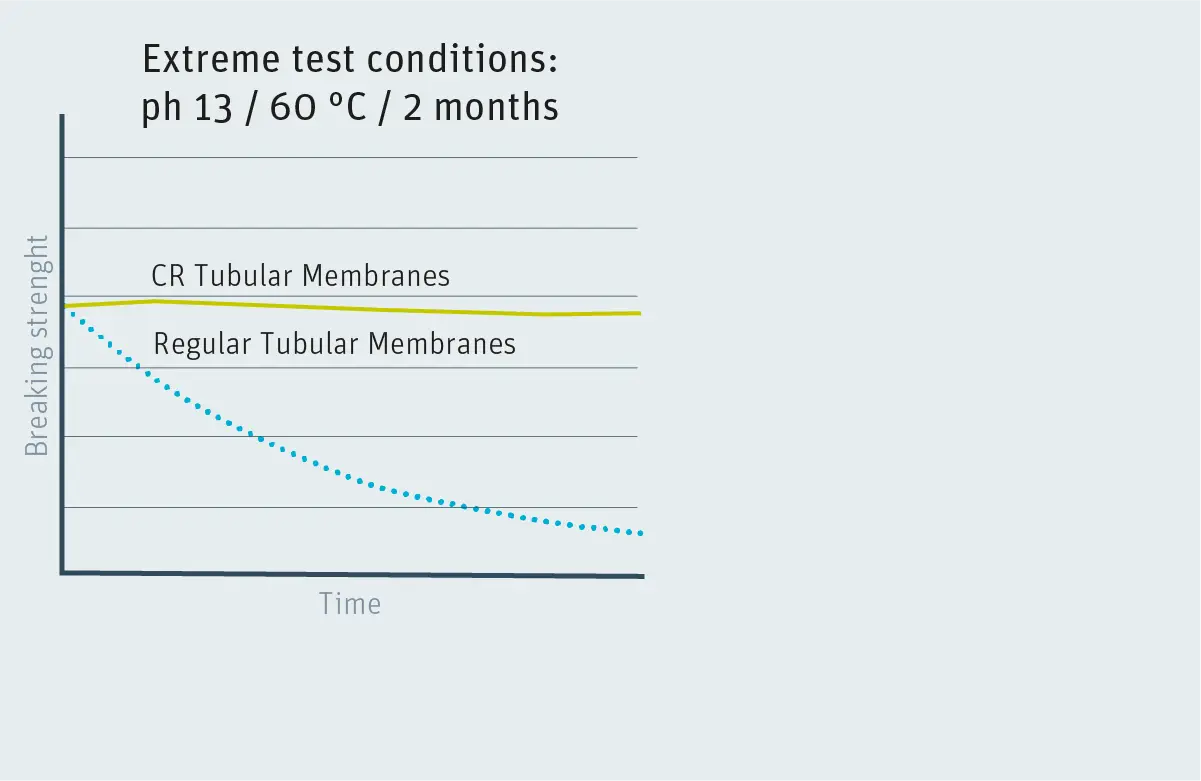
Lime softening precipitation often requires operation at highly alkaline conditions, with pH values frequently exceeding 11. Berghof’s Chemical‑Resistant (CR) tubular UF modules are engineered specifically to perform reliably under these extreme conditions.
Designed for extended chemical resistance across a broad pH range and compatible with aggressive cleaning regimes, CR membranes deliver long‑term stability and exceptional operational flexibility. As a result, they are ideally suited for demanding lime softening applications where conventional membranes would struggle, enabling safe, robust operation even in highly alkaline environments.
Industrial lime softening is a water treatment process used to remove hardness, silica, and dissolved metals from industrial water streams. Lime is added to convert dissolved contaminants into solid precipitates, which can then be separated from the water. The process is widely used for cooling tower blowdown treatment, RO brine recovery, wastewater reuse, and Zero Liquid Discharge (ZLD) systems. When combined with tubular ultrafiltration membranes, lime softening provides reliable solids removal and produces high-quality water for reuse or further treatment.
Lime softening removes hardness-forming ions such as calcium and magnesium as well as silica, which are major causes of membrane scaling. By reducing these contaminants before reverse osmosis, operators can increase water recovery rates, decrease membrane fouling, reduce cleaning frequency, and extend membrane lifetime. Pretreatment with lime softening is especially beneficial in high-recovery water reuse and Zero Liquid Discharge (ZLD) applications.
Lime softening can effectively remove calcium, magnesium, carbonate hardness, silica, and many dissolved heavy metals. Through chemical precipitation, dissolved species are converted into insoluble particles that can be separated from the water. The process is commonly applied to cooling tower blowdown, RO concentrate, industrial wastewater, and process water streams requiring high water recovery and reuse.
Tubular ultrafiltration (UF) acts as a physical barrier that retains all precipitated solids generated during lime softening. Unlike conventional clarification processes, UF does not depend on settling performance or floc formation. This results in stable operation, superior effluent quality, consistent turbidity removal, and reliable protection of downstream equipment such as reverse osmosis systems, evaporators, and thermal concentrators.
Tubular UF is often preferred when wastewater quality fluctuates, space is limited, or very high water quality is required. Compared with clarifiers and multimedia filters, UF provides a smaller footprint, greater process reliability, and consistent solids removal. It is particularly valuable for challenging industrial streams with high suspended solids concentrations, difficult precipitates, or demanding water reuse targets.
Compared with conventional clarification systems, tubular UF offers:
These benefits can significantly improve the economics and reliability of industrial water reuse projects.
Yes. By removing hardness, silica, and other scaling compounds through lime softening, RO and NF brines can be further treated and reused, increasing overall water recovery.
Yes. Many dissolved heavy metals, including nickel, copper, zinc, lead, and chromium, can be removed through chemical precipitation. By increasing the pH with lime or other alkaline reagents, metals form insoluble hydroxides that can be separated efficiently. Tubular ultrafiltration provides reliable retention of the resulting solids and produces a stable, low-turbidity permeate suitable for reuse or discharge.
Lime softening combined with tubular ultrafiltration is used across a wide range of industries, including:
The technology is especially valuable where water reuse, resource recovery, and discharge compliance are critical objectives.
This whitepaper explores the latest approaches to treating industrial wastewater and process streams, with a particular focus on the transition from traditional physico-chemical methods to innovative solutions based on tubular ultrafiltration (UF) membranes.
Readers will gain insights into a range of applications, including brine recovery, cooling tower blowdown softening, and heavy metal removal. The paper also examines the integration of UF membranes with chemical precipitation processes, explaining the technology, its operational advantages, and its performance benefits.
In addition, several real-world case studies demonstrate how this treatment approach supports demanding water reuse and Zero Liquid Discharge (ZLD) objectives across industrial sectors.
Download the whitepaper to discover recent advancements in brine recovery, water softening, and heavy metal removal technologies.