
Home » Industrial Wastewater Applications » Waste Management: Landfill leachate and digestate
Home » Industrial Wastewater Applications » Waste Management: Landfill leachate and digestate

Modern waste management facilities are increasingly challenged by complex liquid waste streams, particularly landfill leachate and digestate from biogas production. These streams are highly loaded with organic matter, ammonia, and persistent contaminants that make conventional treatment methods inefficient or unsustainable.

At Berghof Membranes, we understand these challenges firsthand. With decades of experience and a proven track record in treating even the most demanding leachate and digestate streams, we deliver tubular ultrafiltration solutions that help operators achieve reliable, compliant, and cost‑effective performance. Our robust membrane technology is designed to withstand harsh conditions while maintaining stable operation, giving facilities the confidence to handle today’s toughest wastewater challenges.
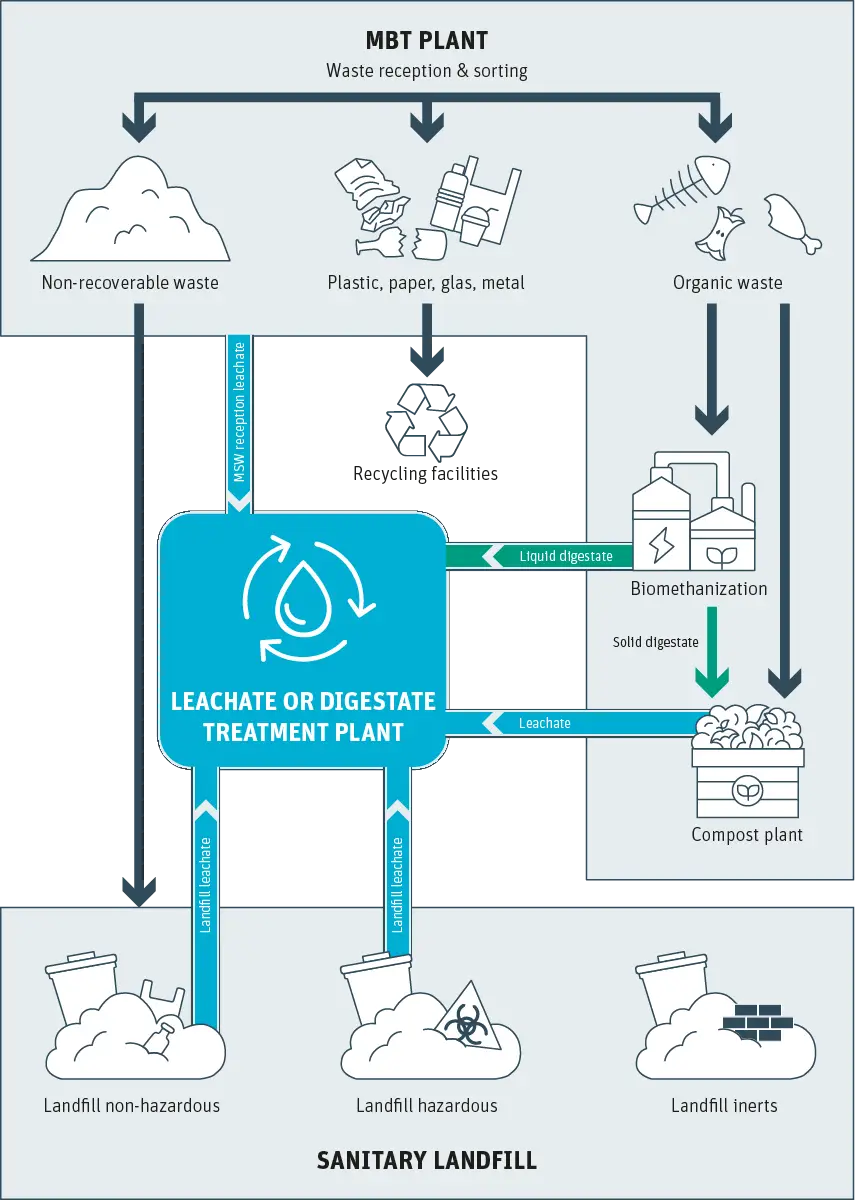
Collection: The initial step involves gathering waste materials from households, commercial establishments and industrial sites. Once these wastes are received in the reception area they are typically directed to the mechanical-biological treatment (MBT) facility.
Sorting: Recyclable and non-recyclable materials are mechanically separated. Simultaneously, any source-separated organic waste is received in a dedicated area.
Recycling: Materials such as paper, plastic, glass and metal are processed to create new products
Treatment: Depending on the type of waste material, various treatments are applied to either valorize the waste or prepare it for disposal. These processes include:
Disposal: Materials that cannot be valorized are disposed of in landfills. Depending on the waste origin, different landfill categories exist:
Across the various waste treatment processes, facilities generate wastewater streams with increasingly complex compositions. One of the most significant of these is the non‑hazardous landfill leachate. In addition, operations such as reception bunkers, composting areas, and inert landfills produce their own leachate or similarly challenging wastewater streams that require reliable treatment solutions.
Digestate presents another major challenge. As the primary by‑product of biogas production, it can represent up to 90 % of the plant’s feedstock volume. Regardless of the biogas plant configuration — whether integrated into MBT facilities for municipal solid waste, or dedicated plants processing manure, agro‑industrial residues, sewage sludge, or other organic waste — operators are facing a growing need for advanced technologies capable of effectively treating digestate.
Landfill leachate typically contains a complex mixture of dissolved organics, ammonia, salts, and heavy metals. Its composition shifts significantly over time: young leachate is rich in biodegradable organics, while mature leachate contains is dominated by refractory compounds and elevated salinity.
Digestate, by contrast, is a dense and heterogeneous blend of liquids and solids, loaded with high levels of suspended solids, colloids, nitrogen, humic substances, and partially degraded organics. Although the two streams differ — leachate being more saline and digestate far more solids laden — both present significant treatment challenges that demand advanced, resilient membrane technologies.
Within this context, tubular UF has emerged as a reliable and versatile solution, effectively supporting two complementary treatment strategies in waste and resource management:
Tubular MBR systems combine biological degradation with robust UF membranes to remove organic matter, suspended solids, and nitrogen compounds. This integrated approach ensures stable performance even with highly variable leachate or digestate quality, enabling facilities to meet stringent discharge limits while maintaining operational reliability
Valorizing digestate through nutrient recovery is one of the most sustainable strategies available, fully aligned with circular‑economy principles. Direct filtration with tubular UF membranes, combined with further concentration processes like RO and evaporation, preserves the nutrients for valorization, producing high-value biofertilizers with reduced use of chemicals.
Both leachate and digestate pose significant challenges when it comes to biodegradability and filtration performance. Their complex composition leads to a mixed liquor that is far less filterable than that produced from municipal sewage or most industrial effluents. Under these harsh conditions, many membrane technologies struggle to maintain stable throughput and acceptable cleaning frequencies.
Tubular UF stands out for its exceptional resilience. Its wide channels, high shear rates, and mechanically robust configuration provide superior resistance to fouling and allow it to handle high solids concentrations, elevated viscosity, and severe fouling loads far more effectively than submerged membrane systems. This strong operational tolerance is the primary reason why, in applications such as landfill leachate and digestate treatment, the vast majority of full‑scale MBR installations rely on external tubular UF modules rather than immersed configurations.
With more than 750 leachate and digestate treatment projects worldwide, Berghof Membranes has built a proven track record in this demanding field. Our long‑standing experience, combined with the durability of our tubular UF technology, enables operators to achieve reliable performance, predictable operating costs, and stable treatment results even under the most challenging conditions.
Advanced digestate management typically involves multiple treatment steps to progressively reduce solids, stabilize the stream, and maximize its resource value. Even after mechanical separation with a decanter centrifuge, the liquid fraction still contains significant levels of suspended and colloidal solids — often up to 2%. These fine particles, together with high viscosity and complex organic components, make the stream especially difficult for most membrane systems to handle.
This is precisely where tubular ultrafiltration (UF) excels. Thanks to its wide channel design, high shear crossflow operation, and inherent mechanical robustness, tubular UF can maintain stable fluxes and long operating cycles even under highly fouling conditions. The technology effectively removes remaining suspended solids, colloids, and high‑molecular‑weight compounds, producing a clarified permeate suitable for downstream processes such as RO, evaporation, or ammonia recovery.
By integrating tubular UF into the digestate treatment train, operators gain a reliable, low‑maintenance barrier against fouling, enabling consistent performance and greater efficiency in the subsequent concentration and valorization steps. In demanding applications like these, tubular UF does not simply enhance process stability: It becomes an essential enabler of advanced, circular digestate management.