Dairy producers rely on advanced wastewater treatment solutions designed to address the specific challenges of their operations. These tailored systems enable reliable compliance with regulatory requirements while improving resource efficiency and supporting sustainability objectives through robust, environmentally responsible processes.

Dairy plants require large volumes of water for cleaning, sanitizing equipment, and processing raw milk into various products. Due to this intensive water consumption, the dairy industry generates significantly greater volumes of wastewater than most other sectors within food and beverage production, with output reaching up to twice the amount of wastewater per liter of milk processed.
Dairy processing involves turning raw milk into products like pasteurized milk, yogurt, cheese, butter, and ice cream. Global demand for these goods is high and growing, leading to increased wastewater production. Consequently, milk processing facilities must comply with rigorous environmental standards for effluent disposal, a task made challenging by the complexity of its composition.
Addressing these requirements involves treatment technologies that are traditionally capital-intensive, and their operation can present both technical and financial challenges. At the same time, water recovery and reuse are rapidly shifting from optional to essential, as freshwater supplies become scarcer and more expensive in many regions. This trend is pushing dairy producers to adopt more advanced, efficient, and resource‑conserving treatment solutions.
Wastewater quality and quantity vary widely depending on production schedules, cleaning procedures and seasonal demand.
Which need to be reduced before discharged to municipal treatment facilities.
Wastewater rich in fats and suspended solids, which can hinder certain biological treatment technologies.
CIP processes add detergents, sanitizers, and inorganic salts, which increase toxicity and alkalinity. Along with milk's hardness, this increases the potential for mineral scaling.
Poor sludge settleability, hampering the conventional activated sludge processes.
Managing dairy wastewater fluctuations while consistently meeting discharge or reuse standards is a demanding task. Implementing advanced, robust biological treatment incorporating Berghof tubular membranes can greatly enhance process reliability, improve contaminant removal, and ensure stable, high‑quality treated water.
Leading OEMs in the global dairy sector have long placed their trust in Berghof’s membrane technology. Milk, cheese, butter, and other dairy producers have successfully applied our solutions for decades. Today, with more than 50 treatment plants operating in dairy facilities worldwide and a combined capacity exceeding 30 million m³ of dairy wastewater treated each year, Berghof Membranes stands as a proven and experienced partner in advanced dairy wastewater treatment.
Dairy wastewater typically contains fats, oils, greases (FOG), and exhibits hardness and alkalinity. Membrane bioreactors with external tubular UF are uniquely suited to manage these conditions: the cross-flow operation, fouling prevention strategies, and adaptive operating modes collectively ensure a reliable and cost-effective solution for processing dairy wastewater.
The external tubular MBR offers a wide range of advantages over both conventional biological processes and submerged MBR systems, making it particularly well‑suited for the complex and variable nature of dairy wastewater:
Robustness
Sudden peaks in organic load, which often overwhelm conventional activated sludge processes and accelerate fouling in submerged MBRs, are managed far more effectively. Thanks to the adaptable filtration conditions, the system can respond quickly to changing wastewater characteristics, ensuring stable, reliable operation under even the most demanding circumstances.
Effluent Quality
Conventional activated sludge systems often struggle with the poor sludge settleability typical of dairy wastewater, making it difficult to consistently meet stringent discharge requirements. In contrast, external MBR technology achieves exceptionally high treatment performance, with COD removal rates exceeding 99%. The resulting effluent is crystal clear, free of suspended solids and FOG, and can present COD levels even below 50 mg/L.
Exceptional tolerance to FOG
Dairy wastewater treatment plants often rely on DAF as a pretreatment step; however, fluctuations in organic load can cause FOG to pass through the system. Berghof’s tubular membranes are highly resilient to these FOG variations and maintain stable performance even when DAF efficiency drops. In many installations, this robustness allows the DAF stage to be reduced or eliminated, resulting in significant savings in chemical usage, operational effort, and sludge handling costs.
Scaling minimized
Dairy wastewater often has high hardness, leading to carbonate precipitation and scaling in submerged MBRs or MBBRs. However, Berghof’s external tubular membranes, using crossflow, form minimal cake layers and greatly lower biomineralization risk, reducing or eliminating the need for chemical pre-treatment required in submerged MBRs.
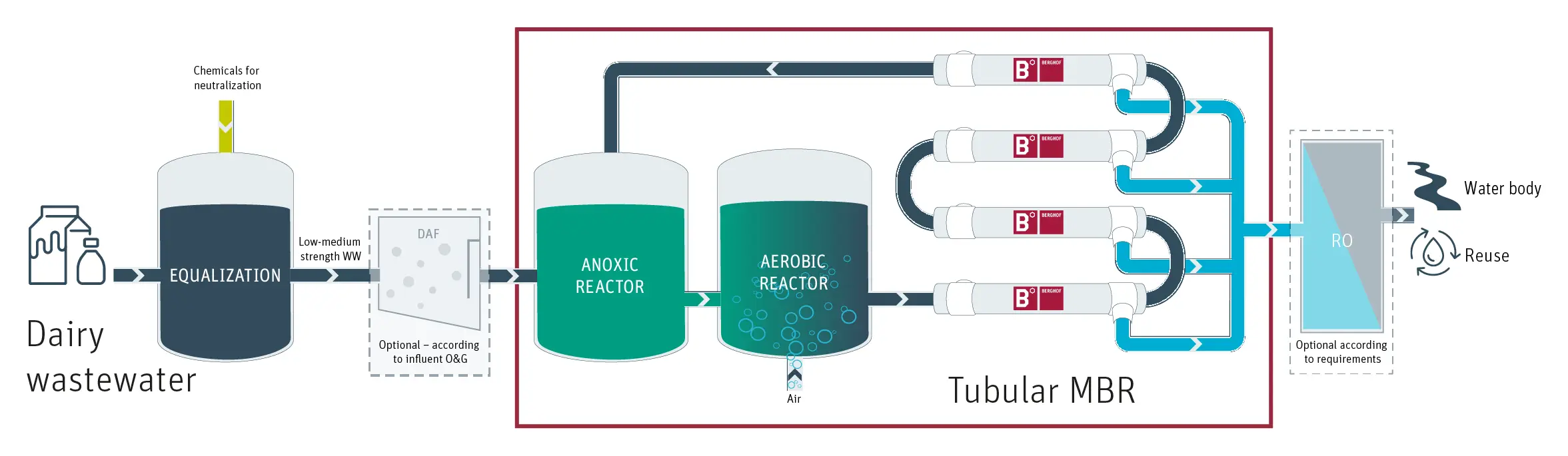
The various waste streams generated throughout dairy processing are first combined in an equalization tank. Because cleaning and sanitizing operations typically involve both acidic and alkaline chemicals, the incoming wastewater often has a highly variable pH. As a result, chemical dosing is usually required in the equalization tank to achieve proper neutralization.
For high‑fat dairy products such as butter, the wastewater can contain elevated concentrations of FOG. In these cases, a DAF system is commonly installed as a pre‑treatment step.
The core treatment stage is the external MBR, which is well‑suited for low‑ to medium‑strength dairy effluents. When nitrogen removal is required, the biological process is configured with both anoxic and aerobic zones. If nitrogen is not a concern, a single aerated bioreactor is sufficient for the removal of organic contaminants.
The MBR produces an effluent that fully meets discharge standards for release into a receiving water body. Alternatively, it can be reused for non‑contact applications such as steam generation and cooling towers. For reuse scenarios that require deionized water quality, a final polishing step with reverse osmosis is incorporated.
AnMBR technology is widely recognized as the most advanced solution for treating high‑strength dairy wastewater. Offering a favourable net energy balance and delivering exceptional effluent quality that eliminates the need for complex post-treatment, this technology demonstrates strong competitiveness regarding both operational and capital expenditures.
The Anaerobic MBR is a compact and highly efficient wastewater treatment system that integrates anaerobic digestion with robust tubular UF membranes. This combination offers substantial advantages over conventional anaerobic technologies.
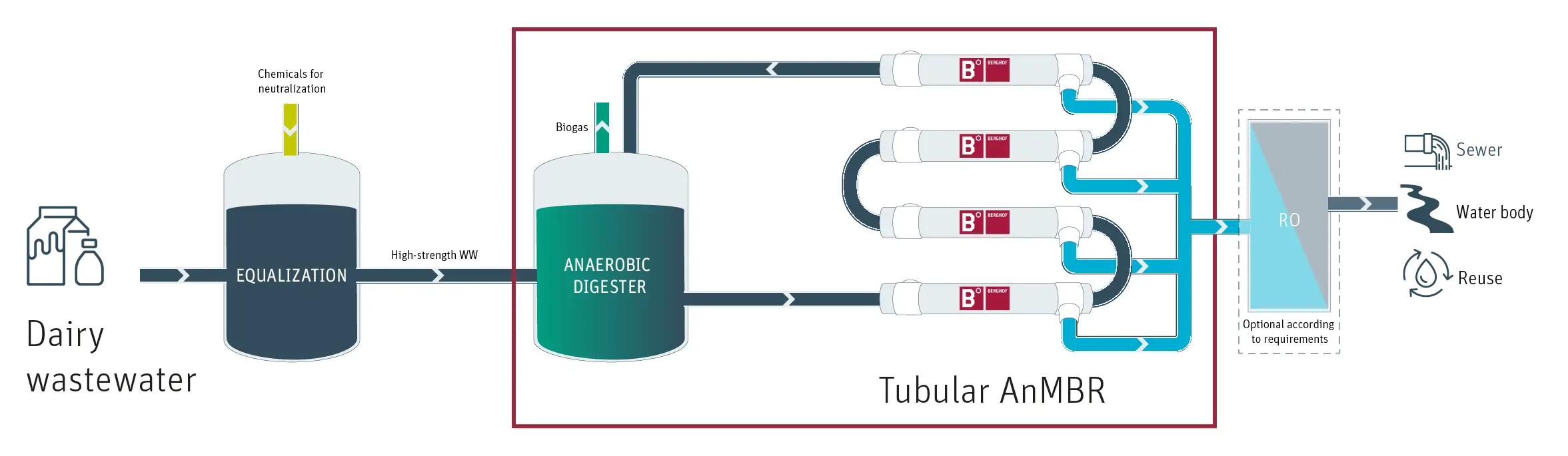
Berghof tubular UF is coupled to a simple CSTR digester, allowing the operation with high OLRs while producing a high-quality effluent. UF membranes ensure the complete retention of biomass within the anaerobic reactor and bring a significant improvement in the digestion process, making it more robust, and increasing conversion of organic matter into biogas.
AnMBR systems equipped with Berghof tubular membranes offer decisive advantages for dairy wastewater treatment compared to conventional anaerobic granular sludge technologies.
Effluent Quality
COD removal rates up to 98 – 99 %, combined with complete solids retention, ensuring consistently high quality effluent suitable for direct discharge or, when required, for polishing through RO to enable water reuse within the dairy facility.
Ability to handle high TSS and FOG
Unlike granular anaerobic systems, which are prone to degranulation under these conditions, leading to biomass washout, reduced efficiency, and poorer effluent quality, AnMBR maintains stable performance even when exposed to elevated TSS and FOG levels.
Cost Savings in Pre and Post-Treatment
As a result of the better effluent quality and the ability to cope with high TSS and FOG, pre- and post-treatment are simplified. Biogas production is maximized, enhancing the overall energy efficiency.
In some treatment configurations, aerobic and anaerobic MBR technologies are integrated within the same facility to manage wastewaters with different organic load levels. This combined approach enables optimal performance when both very high and low‑to‑medium COD streams must be treated. By assigning each wastewater fraction to the most suitable biological process, the installation achieves superior effluent quality while ensuring minimum operational costs.
High‑strength dairy wastewater and by‑products like whey are first blended in the equalization tank. Because dairy processes use acidic and alkaline cleaners, the incoming streams often have widely varying pH levels, so chemical dosing is needed to neutralize pH. Nutrients and micronutrients are usually added at this stage as well.
The tubular anaerobic MBR then removes the organic load in a single, streamlined treatment step, while simultaneously producing renewable energy in the form of biogas and generating a high‑quality effluent. This treated water can generally be discharged to the sewer, and in many cases, it even meets the criteria for direct discharge into natural water bodies. When additional polishing is required, the effluent can be further treated with RO, enabling its reuse within the facility.