
Home » Industrial Wastewater Treatment by Industry | Berghof Membranes » Energy and Oil & Gas
Home » Industrial Wastewater Treatment by Industry | Berghof Membranes » Energy and Oil & Gas

The energy sector, and particularly the oil and gas industry, is among the most water‑intensive industrial sectors worldwide. Water is an essential resource across the entire value chain, from upstream extraction and production, through midstream transport, to downstream refining and petrochemical processing. As a consequence, very large volumes of wastewater are generated, often with complex and highly variable compositions. Effective wastewater treatment is therefore a critical technical, environmental, and regulatory challenge for industry.

Water plays multiple roles in energy and oil & gas operations. In upstream activities, it is used for drilling fluids, well stimulation, and hydraulic fracturing, where large volumes of water are injected underground to release hydrocarbons from tight formations. During production, significant quantities of produced water — naturally occurring formation water brought to the surface together with oil and gas — are generated. As fields mature, the water‑to‑oil ratio typically increases, making water management even more critical over time.
In midstream and downstream operations, water is extensively used for cooling, steam generation, desalting, and cleaning processes. Refineries and petrochemical plants rely on water for heat exchange systems, boilers, and numerous chemical processes. Additionally, cooling tower blow down, boiler blow down, and process wash waters further contribute to the total wastewater volume. Altogether, these activities make the sector one of the largest industrial water users, particularly in regions where water scarcity is already a concern.
The oil & gas industry encompasses multiple activities — from production and processing to refining and petrochemicals — each generating large volumes of complex wastewater. At every stage, tailored treatment technologies are required to meet stringent discharge or reuse standards.
Likewise, the broader energy sector consumes significant water and produces substantial wastewater streams. As water resources become more constrained, reuse strategies are increasingly adopted, with cooling tower blowdown emerging as a major wastewater management challenge driving advanced treatment and recycling solutions.
Wastewater contains oil, suspended solids, high organic loads, salts, and inhibitory compounds, requiring highly robust and reliable treatment technologies.
Tight discharge limits for oil, organics, nutrients, and toxins, particularly in environmentally sensitive and water-stressed regions.
Growing demand for advanced wastewater treatment solutions to achieve higher effluent quality, enable water reuse, and reduce freshwater intake.
Tubular UF technology is applied in a range of solutions tailored to address the unique characteristics of each specific wastewater stream throughout the energy and oil & gas industry.
For refinery and petrochemical wastewater, tubular MBR stands out as an excellent option, delivering robust treatment performance even in the presence of complex contaminants.
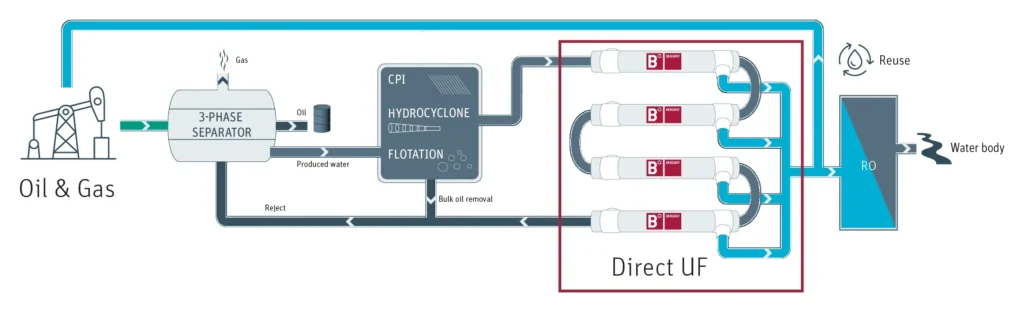
When utilized as a direct UF solution, tubular UF demonstrates high efficiency in treating oily wastewater, achieving effective removal of emulsified oil and hydrocarbons.
In addition, when tubular UF is integrated with chemical precipitation for softening, it provides an optimal approach for treating and recovering water from cooling tower blowdown and similar waste streams, further supporting resource conservation and regulatory compliance.
The external MBR with Berghof tubular membranes is known to be one of the best available technologies for dealing with refinery wastewater, especially when reuse practices are implemented.
The most common treatment configuration combines an initial DAF step to remove the bulk oil, followed by the MBR. Berghof tubular membranes are well suited to handle residual emulsified hydrocarbons that may pass through the DAF, ensuring stable and reliable operation even with the most complex refinery effluents.
Tolerance to oil & grease
High tolerance to emulsified hydrocarbons that may leak from DAF pretreatment, ensuring stable and trouble-free operation.
Superior fouling resistance
Due to crossflow operation, which helps maintain consistent membrane performance and reduces maintenance requirements.
Flexibility and resiliency
Adaptable to varying influent characteristics and capable of handling refractory components, toxicity, or inhibiting compounds that challenge conventional biological treatments.
Effluent quality
Long SRT and a more specialized biomass enable COD removals above 95% and complete nitrification.
Refinery and petrochemical wastewater is primarily treated to remove organic contaminants through biological processes. Following equalization and pH adjustment, dissolved air flotation is used to remove free and emulsified mineral oils. The clarified stream is then treated in the external MBR, enabling efficient biodegradation of dissolved hydrocarbons, phenolic compounds and other soluble organic compounds. The result is a high‑quality effluent suitable for discharge or reuse, with further polishing options such as RO available for desalination when required.
Oily wastewater treatment is now a priority across industries due to stricter environmental regulations and sustainable practices. Tubular UF membranes offer an effective way to remove oil, solids, and other pollutants with consistent results, minimal chemicals, and compact design. Their efficiency and reliability make them a cost-effective, eco-friendly option for oily water treatment in sectors such as oil & gas, automotive, metalworking and bilge water treatment.
Excellent at handling high oil loads
Tubular UF handles very high oil concentrations (even over 100,000 mg/L) much better than hollow fiber or spiral wound configurations, which foul rapidly in oily conditions. This allows for high recovery rates and greatly reduces the need for pre-treatment.
High-quality permeate
UF removes free, dispersed, and emulsified oil, delivering a highquality permeate with typically less than 5 mg/L oil.
Highly resistant to fouling
Tubular UF, with its large internal diameter and turbulent crossflow, offers optimal performance.
Lower operating cost compared to DAF + chemical treatments
UF eliminates or drastically reduces the need for coagulants, polymers and demulsifiers.
Treating oily waters with tubular UF is a straightforward process. Due to the high tolerance of tubular UF to oil and grease, particles, and colloids, pre-treatment requirements are minimal. Before the tubular UF, just a simple system for removing free oil and coarse solids is implemented, typically addressed with oil traps, oil skimmers, or CPI systems.
Tubular UF, with typical recoveries greater than 90 – 95 %, produces a high-quality permeate along with a concentrated, oil‑rich reject stream. This concentrate can either be recovered and valorized as a useful by‑product or, if preferred, handled through external waste‑management channels.
Power plants and refinery or petrochemical facilities are known to generate large volumes of cooling tower blowdown (CTBD) as part of their routine operations. With growing efforts to minimize the water footprint and achieve ZLD or MLD, recovering these streams, often characterized by high hardness and silica concentrations, becomes increasingly attractive. By integrating tubular UF with lime precipitation, this recovery is accomplished through a straightforward process arrangement and with reduced chemical consumption.
Effluent quality
Permeate offers significantly better quality than water treated by clarifiers, providing total elimination of suspended solids, turbidity levels under 1 NTU, and an SDI below 3. It is suitable for direct input into the RO system, making it unnecessary to use intermediate stages like multimedia filters or hollow fiber membranes.
Full reliability
Changes in feed water quality can reduce the performance of clarifiers and multimedia filters. UF membranes act as a full physical barrier to precipitates, reliably ensuring solids-free permeate regardless of process variation.
Less chemicals
Coagulants and flocculants are not needed, nor is excess lime for coagulation of fine precipitates. Consequently, chemical use is usually 25 – 30% lower than in conventional gravity-settling processes.
Compactness
Only a single separation step is required upstream of the RO system, resulting in a significantly reduced overall footprint. Compared with conventional treatment trains — including clarifiers, multimedia filters, and hollowfiber UF — this configuration achieves space savings of more than threefold.
The CTBD stream first enters the chemical precipitation tank. Depending on the specific treatment requirements, one or two reaction tanks may be installed. A two‑stage precipitation setup can provide a more efficient process in certain applications, enhancing pollutant removal and optimizing chemical consumption. During this stage, the required chemicals are added and pH is precisely controlled.
After precipitation, the water flows to the tubular UF system. The UF membranes separate and concentrate the precipitated solids, producing a high‑quality permeate with low TDS and a concentrated reject stream. Following neutralization, the permeate is fed directly to the final RO system to achieve ZLD. The solids‑rich reject is routed to a filter press for final solid–liquid separation, while the liquid filtrate from the press is typically returned to the precipitation tank to maintain process efficiency and minimize waste volume.