
Home » Case Studies » Microelectronics Industry | Plating and Backside Metallization Wastewater Treatment
Location: Philippines
OEM: MTI Water Technologies, Inc.
Product: B-SMART® Performance
Capacity: 745 m3/day
Membrane: 5 mm, PVDF
Wastewater in this context is primarily produced during the plating and backside metallization processes, which involve a series of interconnected tanks where various chemicals are introduced at different stages. These tanks facilitate essential steps such as cleaning, plating, rinsing, and surface finishing, resulting in effluents containing a mixture of solids, metals, organic compounds, and other contaminants. As a result, the microelectronics producer faced the complex challenge of removing these pollutants efficiently and reliably, necessitating a tailored treatment solution suitable for their operational requirements and environmental responsibilities.
In seeking a solution for their wastewater management, the customer prioritized a treatment technology that was not only highly efficient and robust, but also capable of consistently producing high-quality treated water suitable for regulatory compliance. Moreover, due to the limited available space within the factory, a reduced footprint was a key criterion in the selection process, ensuring that the chosen system could be seamlessly integrated without necessitating significant alterations to the existing layout.
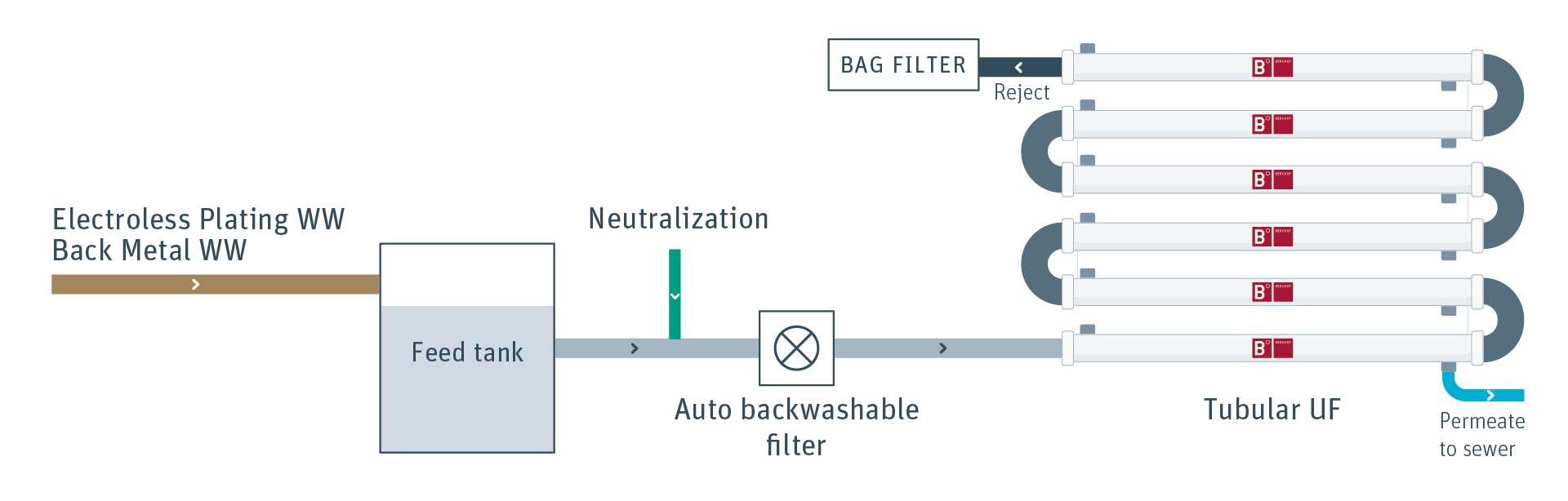
To address the specific requirements of the microelectronics producer, MTI Water Technologies decided to install a Berghof tubular ultrafiltration (UF) system. The solution comprised two separate units, each consisting of four modules arranged in series and equipped with 5 mm diameter membranes, offering a membrane area of 46.1 m² per module. This configuration, with a total of 369 m² membrane area, was designed to handle the facility’s daily wastewater flow of 745 m³.
This microelectronics wastewater stream consists of the combined effluent from the rinsing baths of both electroplating plants, the wastewater produced by the backside metallization process, and the reject generated from a reverse osmosis system used for process water preparation. This stream exhibits varying TSS between 150 and 480 mg/L, mainly due to the presence of silicon microparticles.
The treatment system follows a fully integrated process sequence consisting of feed tank, chemical dosing for pH adjustment using hydrochloric acid (HCl) and sodium hydroxide (NaOH), followed by an auto backwashable filter used as a pre-screening stage for removal of coarse suspended solids. The pre-treated stream is then pumped to the tubular UF system, where fine solids and particulates are removed. The permeate is discharged to the sewer in compliance with regulatory standards, while the UF reject stream is routed through a bag filter and subsequently returned to the feed tank for recirculation and recovery optimization.
The system is operated under a preventive maintenance program, with periodic clean-in-place (CIP) procedures conducted quarterly to ensure stable membrane performance and long-term operational reliability. The CIP process involves sequential low-pH cleaning using citric acid for inorganic scaling removal, high-pH cleaning using sodium hydroxide for organic foulant removal, and a final disinfection stage using sodium hypochlorite. Each stage is followed by thorough flushing to ensure complete chemical removal and restoration of membrane performance.
The microelectronics wastewater treatment plant was successfully commissioned in 2023, marking a significant milestone in the project’s development. This achievement has enabled the facility to effectively manage and treat effluent streams with advanced technology, setting a new standard for operational efficiency and environmental compliance.
The plant enables the facility to comply fully with discharge requirements, producing treated water free of suspended solids, with COD values consistently below 100 mg/L. This high quality of effluent demonstrates the effectiveness of the advanced treatment processes implemented on site. As a result, the customer benefits from reliable, environmentally responsible operations and reduced risk of non-compliance penalties.
The moderate concentration of suspended solids in the feed allows the use of modules equipped with 5 mm diameter membranes. This design choice, despite the compact membrane size, enables the system to achieve a remarkable recovery rate of 95 %. Operating at a crossflow velocity of 3 m/s and delivering a permeate flux of
80 LMH, the treatment plant maintains a specific energy consumption of approximately 1.5 kWh per cubic meter, demonstrating both efficiency and cost-effectiveness.

Discover how a microelectronics producer in the Philippines treats plating and backside metallization wastewater using tubular ultrafiltration, achieving 95% recovery and consistently low COD levels.

This case study shows how direct filtration with tubular ultrafiltration membranes enables efficient recovery of valuable metals from industrial wastewater while optimizing energy use and process reliability.

This case study shows how tubular UF technology enhances wastewater treatment and enables efficient recovery of valuable metals in the microelectronics industry.