Automotive Industry | MBR Wastewater Treatment Philippines

Project Details

Location: Philippines
Product: Tubular UF membranes
Produced Permeate: > 20 m³/hour
Membrane: 8 mm, PVDF, backwashable

Project Overview

A leading car factory needed to expand their existing wastewater treatment system at one of their manufacturing facilities located in the Philippines. The existing conventional activated sludge system was unable to handle the higher flow rate and urgently needed an upgrade.

The Challenge

Due to Philippine land restrictions, the company was not permitted to expand beyond the existing wastewater treatment area. After a comprehensive review of various technologies and options, the car manufacturer awarded the project to a local OEM for their external tubular membrane solution from Berghof Membranes. The main reason for awarding this project was that the technology enabled the end-user to generate a bigger flow without expanding the existing footprint.

The wastewater stream generated by the automotive plant varied in characteristics and strength as it included discharge streams from various sectors within the plant. These sectors included:

  • painting bath
  • chassis
  • degreasing
  • assembling
  • phosphating
  • scrap yard
  • ED coating
  • welding
  • others (cooling tower, boiler, sanitary)

The different streams were processed in separate units (i.e. coagulation / flocculation, dissolved air flotation, sedimentation) before the final stage in a biological treatment unit.

The previous biological treatment design was a conventional activated sludge process with two aeration basins, each 150 m³, positioned in parallel to provide a total volume of 300 m³ for the bioreactor. After the aeration system, wastewater from both basins flowed towards a common clarifier to separate the effluent and sludge.

The Berghof Membranes Solution

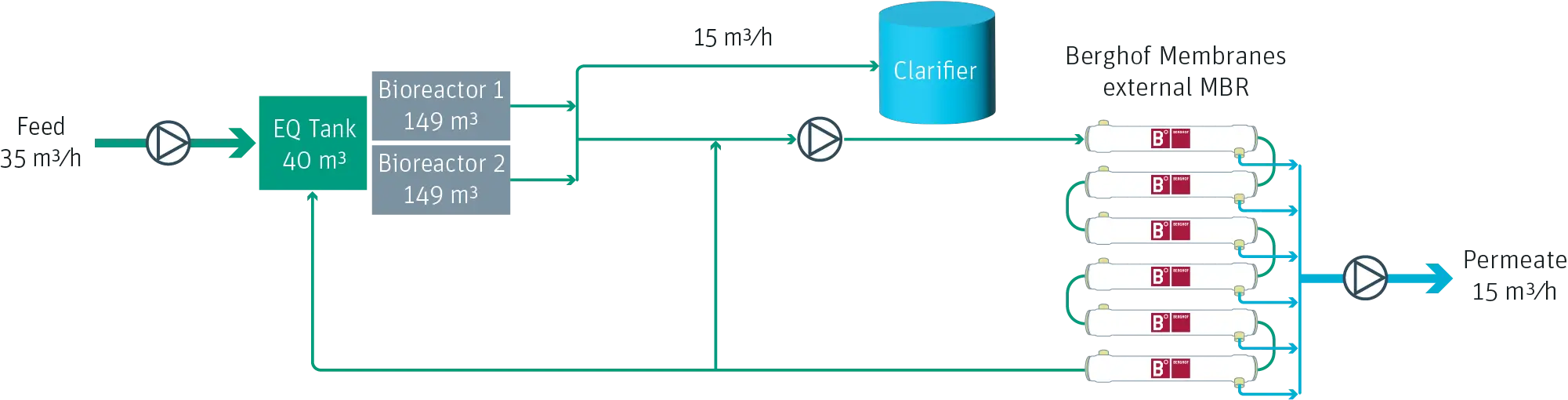
The sludge of the membrane bioreactor (MBR) was separated by External Ultrafiltration of Berghof Membranes. The system was designed as a single loop with 6 modules in series. To leverage the footprint of the existing wastewater treatment system, the skid was positioned on top of the aeration tank.

Aside from the small footprint of the ultrafiltration system itself, the winning technology is able to concentrate double the amount of biomass, which enabled the use of a smaller bioreactor for the end-user.

The diagram below is a representation of the project winning schematic presented by the OEM to the client – a schematic that features the external MBR technology coupled with Berghof Membranes. The table on the right shows the target process parameters.

ParametersInfluentRequired Effluent
Feed Flow rate, m3/h3520
COD mg/L827.5≤ 20
BOD, mg/L305≤ 10
TSS, mg/L147≤ 3,000
ph8.56.5 – 8.5
Schematic diagram of WWTP at car manufacturing factory

Customer benefits

The Berghof UF skid achieved a constant flow rate greater than the original target of 20 m³/h. The flux has remained stable in the range of 65 LMH, while the system’s crossflow velocity has been between 1.5 – 2.4 m/s.

The permeate has successfully met the effluent discharge standards and is partially reused for the manufacturing facility’s cooling tower and other general processes. The excess water is discharged to the river nearby and the thickened sludge is transported with trucks after being belt pressed and dried.

View similar case studies

Automotive Industry | MBR Wastewater Treatment Philippines
Automotive Industry | MBR Wastewater Treatment Philippines
Learn how tubular ultrafiltration membranes helped an automotive manufacturer treat variable wastewater streams and support water reuse goals.

Automotive Industry | MBR Wastewater Treatment

Automotive Industry | MBR Wastewater Treatment

This case study shows how an automotive plant uses MBR technology to treat variable wastewater streams, improve effluent quality, and enable partial water reuse.

Landfill Leachate | MBR Wastewater Treatment

Landfill Leachate | MBR Wastewater Treatment

This case study highlights how an advanced MBR system tackles highly contaminated landfill leachate, delivering stable treatment performance and high-quality effluent for strict discharge requirements.