
Home » Case Studies » Food Industry | MBR Wastewater Treatment for Potato Processing
Home » Case Studies » Food Industry | MBR Wastewater Treatment for Potato Processing
Location: Péruwelz, Belgium
OEM: Aaqua NV
Application: MBR
Capacity: 1,200 m3/day
COD feed: Average 900 mg COD/L
Membrane: 8 mm, PVDF (Loop 1) and PES (Loop 2), backwashable
Ecofrost is one of Europe’s leading producers of frozen potato products, transforming premium potatoes into high-quality french fries and speciality potato products enjoyed in more than 150 countries worldwide. Founded in 2003 and based in Péruwelz, Ecofrost combines advanced processing technology, rigorous food safety standards, and a strong commitment to sustainability. Through investments in wastewater treatment, biogas generation, energy recovery and CO₂ reduction, the company continues to grow while reducing its environmental footprint and delivering excellence to customers across the retail, foodservice, and industrial sectors.
To address the challenge of reducing its water footprint, Ecofrost selected Aaqua to deliver an integrated treatment solution comprising an external membrane bioreactor (MBR) followed by reverse osmosis (RO). Commissioned in November 2025, the system maximizes treated-water recovery and enables the production of high-quality water for reuse. This minimum liquid discharge approach reduces freshwater demand and minimizes the volume of liquid effluent requiring disposal.
The project was implemented as an upgrade and expansion of Ecofrost’s existing wastewater treatment facility. The original treatment process relied on a secondary clarifier downstream of the biological stage. To accommodate the increased hydraulic and organic load resulting from the commissioning of a new production line, Aaqua converted the conventional activated sludge into MBR, by integrating two tubular ultrafiltration (UF) loops followed by an RO system.
Ecofrost is already planning a further production expansion, with an additional production line expected to come online in the near term. Anticipating this future growth, the UF system was designed with sufficient scalability and reserve capacity. As a result, the upgraded installation is expected to be capable of handling the additional load without requiring any modification.
Water reuse was a key project driver because Ecofrost has limited access to unicipal tap water and is also subject to restrictions on the volume of groundwater it may abstract. Although a separate nanofiltration and RO system is already used on site to treat groundwater, the RO stage installed after the external MBR provides an additional and more resilient source of high-quality reuse water. The recovered water is reused as boiler feed water in boiler tanks and within the production process, reducing reliance on constrained freshwater supplies and supporting continued production growth.

Potato products manufacturing generates wastewater that is rich in starch and has a high organic content. This wastewater type has variable characteristics and requires careful flow management, process stability, and consistent treatment performance. Ecofrost needed a solution that could accommodate a peak treatment volume of 1,200 m³/day and manage a COD load of 1,080 kg/day.
Beyond regulatory compliance, Ecofrost aimed to reduce operational costs by reusing the treated water in its production process. The treatment plant therefore had to deliver high treatment efficiency, consistently excellent effluent quality, and the flexibility to cope with variable operating conditions.
One of the main challenges was integrating the new treatment installation into Ecofrost’s existing operating facility. The available infrastructure, process connections and space constraints required careful engineering to fit the new equipment into the existing treatment train while minimizing disruption to ongoing production.
The plant also required stable, robust and fully automated operation. Because the installation runs continuously, 24 hours a day, while operators are normally present only during daytime hours, the system had to operate reliably with limited manual intervention. A high degree of automation, effective process monitoring and suitable alarm and control functions were therefore essential to maintain performance outside staffed hours.
In addition, the treatment solution needed to cope with variable, starch-rich wastewater while consistently producing high-quality permeate for downstream RO treatment and reuse. The overall design therefore had to combine operational flexibility, low maintenance requirements and dependable membrane performance under demanding food-industry conditions.
The project began with a pilot trial to validate the MBR process under Ecofrost’s actual wastewater conditions and confirm the suitability of tubular ultrafiltration for the full-scale installation. Following the successful pilot phase, Aaqua supplied a complete turnkey treatment solution, with the tubular MBR as the core biological treatment step.
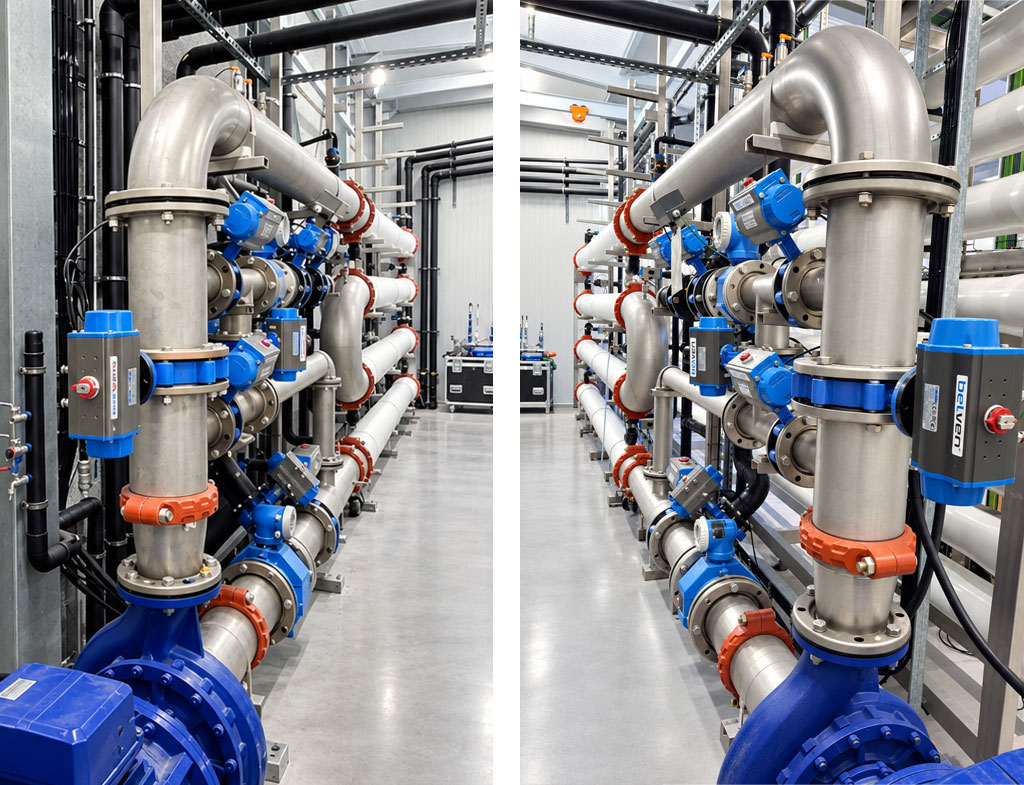
The tubular UF system connected to the bioreactor is arranged in two independent loops, each fitted with four 10-inch, 4 m membrane modules. The layout is prepared for future expansion to six modules per loop, allowing additional membrane capacity to be installed as treatment requirements increase.
To support stable long-term operation at these high fluxes, the UF package incorporates a high degree of automation and complementary fouling-control strategies. Programmed relaxation, backwashing and chemically enhanced backwashing (CEB) can be applied as required, helping to control reversible fouling, maintain membrane permeability and reduce the need for manual intervention.
Starch-rich wastewater from the production process first passes through sieve bends, which remove solids larger than 3 mm. The screened stream is then directed to an acidification tank before entering a lamella separator, where it is divided into thick and thin fractions. The thick fraction is sent to the grey-starch decanter, while the thin fraction flows directly to the mixing tank. From there, wastewater is treated in an UASB reactor to reduce the organic load before entering the aerobic MBR, producing a solids-free and high-quality permeate. Finally, RO provides the required polishing to generate high-quality water for reuse on site.
The existing UASB reduces the organic load of the starch-rich wastewater by removing approximately 80 % of the COD, lowering the average concentration from 4,720 mg/L to 900 mg/L. Afterwards, the tubular MBR plant successfully meets the project’s performance targets, achieving COD removals of more than 97 % and producing an average effluent COD of just 25 mg/L. The system generates approximately 1,200 m³/day of high-quality permeate, free of suspended solids and turbidity, which is subsequently polished by the RO system, where conductivity is reduced from average 4350 to 180 μS/cm.
The tubular UF system has demonstrated outstanding hydraulic performance, combining exceptionally high productivity with robust and stable operation. Under average operating conditions of 32 °C and a crossflow velocity of 3.8 m/s, the system consistently achieves permeate fluxes above 150 LMH, underscoring the effectiveness of the membrane configuration for treating demanding food-industry wastewater.
Following the MBR stage, RO provides the final polishing required to produce water of a sufficiently high quality for demanding reuse applications. This enables Ecofrost to reuse approximately 650 – 700 m³/day for raw potato washing and boiler make-up water. By replacing municipal water in this process, the company saves the equivalent volume of freshwater each day while also avoiding the sewer discharge fees that would otherwise apply to the treated effluent.
| Parameters | Required Effluent |
|---|---|
| Capacity | 1,200 m3/day |
| Average inlet COD | 900 mg/L |
| Average MBR effluent | COD 25 mg/L |
| COD removal | ≥ 97 % |
With a clear commitment to identifying new and improved solutions and maintaining a leading position in the market, Aaqua became an early adopter of Berghof’s newly developed PES-LE membrane chemistry. By evaluating the technology under real operating conditions, Aaqua helped to demonstrate its potential as a future-ready alternative for high-strength MBR applications. The system’s two independently operated, parallel membrane loops enabled Aaqua to directly benchmark the new-generation PES-LE (100 kDa) membrane chemistry against the standard PVDF (30 nm) membrane chemistry, typically used in MBR systems, under comparable process conditions. This provided a reliable basis for assessing differences in permeate output, operational stability, and fouling behaviour. The figure below highlights the trends in the main performance parameters throughout the study, with each dot representing one week of operation.
As regulatory requirements and sustainability expectations continue to evolve, water and process industry operators are increasingly seeking filtration technologies that combine high performance with environmentally conscious materials.
Berghof Membranes is expanding its product portfolio with a new generation of Polyethersulfone (PES) membranes designed to deliver reliable filtration performance while supporting sustainability goals. Its backwashable design helps maintain stable performance, reduce maintenance effort and support demanding applications while
preparing operators for future sustainability and regulatory requirements. Evaluated under real operating conditions and benchmarked against the proven PVDF membrane chemistry, the technology delivered comparable permeate output and system stability. These initial results position the new-generation PES membrane chemistry as a PFAS-free and BPA-free option for new projects, retrofits and future membrane replacement strategies, combining regulatory readiness with robust operational performance.
With the launch of the new-generation PES tubular membrane portfolio, Berghof Membrane Technology GmbH is demonstrating its commitment to combining technological innovation with sustainability, and to meeting future regulatory requirements. The next phase of comparisons will focus on the performance of the new-generation PES 30 nm membrane option against the established PVDF 30 nm membranes.


Discover how Ecofrost treats starch-rich wastewater with tubular MBR technology, achieving ≥ 97 % COD removal and enabling 650 – 700 m³ of water reuse per day.

Discover how AnMBR technology turns high-strength distillery wastewater treatment into an opportunity for biogas production, energy recovery, and greater sustainability.
Learn how tubular ultrafiltration membranes helped an automotive manufacturer treat variable wastewater streams and support water reuse goals.